In today’s fast-paced digital era, buzzwords like Artificial Intelligence (AI), Machine Learning (ML), and Deep Learning (DL) often dominate conversations across tech, healthcare, marketing, and more. But what do these terms really mean? Are they the same? Or do they serve different roles in the tech ecosystem?
This blog will clear up the confusion between AI, ML, and DL. We’ll explore their definitions, how they relate, and where each is used in real life. Whether you’re a tech enthusiast, entrepreneur, or a student, this guide will help you understand the real difference.
What is Artificial Intelligence (AI)?
Artificial Intelligence is a broad field of computer science that focuses on creating intelligent machines that can mimic human behavior. It includes learning, reasoning, problem-solving, perception, and language understanding.
AI is the umbrella under which both ML and DL fall. It aims to simulate human intelligence to perform tasks like decision-making, visual perception, and language translation.
Common Applications of AI:
- Voice assistants like Siri and Alexa
- Chatbots and customer support systems
- Autonomous vehicles
- Smart home devices
- Fraud detection systems
What is Machine Learning (ML)?
Machine Learning is a subset of AI. It allows computers to learn from data without being explicitly programmed. Instead of being manually coded to perform a task, ML algorithms are trained on data and improve their performance over time.
The main goal of ML is to enable machines to learn patterns and make predictions or decisions based on data.
Types of Machine Learning:
- Supervised Learning: The algorithm learns from labeled data. Example: Spam detection in emails.
- Unsupervised Learning: The algorithm finds hidden patterns in unlabeled data. Example: Customer segmentation.
- Reinforcement Learning: The system learns through trial and error to maximize rewards. Example: Game-playing AI like AlphaGo.
Common ML Use Cases:
- Product recommendations (e.g., Amazon, Netflix)
- Medical diagnosis and imaging
- Stock market predictions
- Language translation
What is Deep Learning (DL)?
Deep Learning is a subset of Machine Learning. It uses neural networks with multiple layers (hence the term “deep”) to analyze various factors of data. Inspired by the structure of the human brain, DL can process massive amounts of data and discover complex patterns.
Deep Learning is the driving force behind many advanced AI applications, including computer vision and natural language processing.
Popular Deep Learning Applications:
- Facial recognition systems
- Self-driving cars
- AI-generated content (text, images, videos)
- Voice recognition (e.g., Google Assistant)
Key Differences Between AI, ML, and DL
| Aspect | Artificial Intelligence (AI) | Machine Learning (ML) | Deep Learning (DL) |
|---|---|---|---|
| Definition | Machines mimicking human intelligence | Algorithms learning from data | ML using multi-layered neural networks |
| Scope | Broadest | Subset of AI | Subset of ML |
| Data Requirement | Can work with structured rules | Requires moderate data | Needs a large amount of data |
| Hardware Requirement | Low to moderate | Moderate | High (uses GPUs) |
| Use Case Complexity | Basic to advanced | Intermediate | Highly complex tasks |
How Are They Related?
Think of it like this:
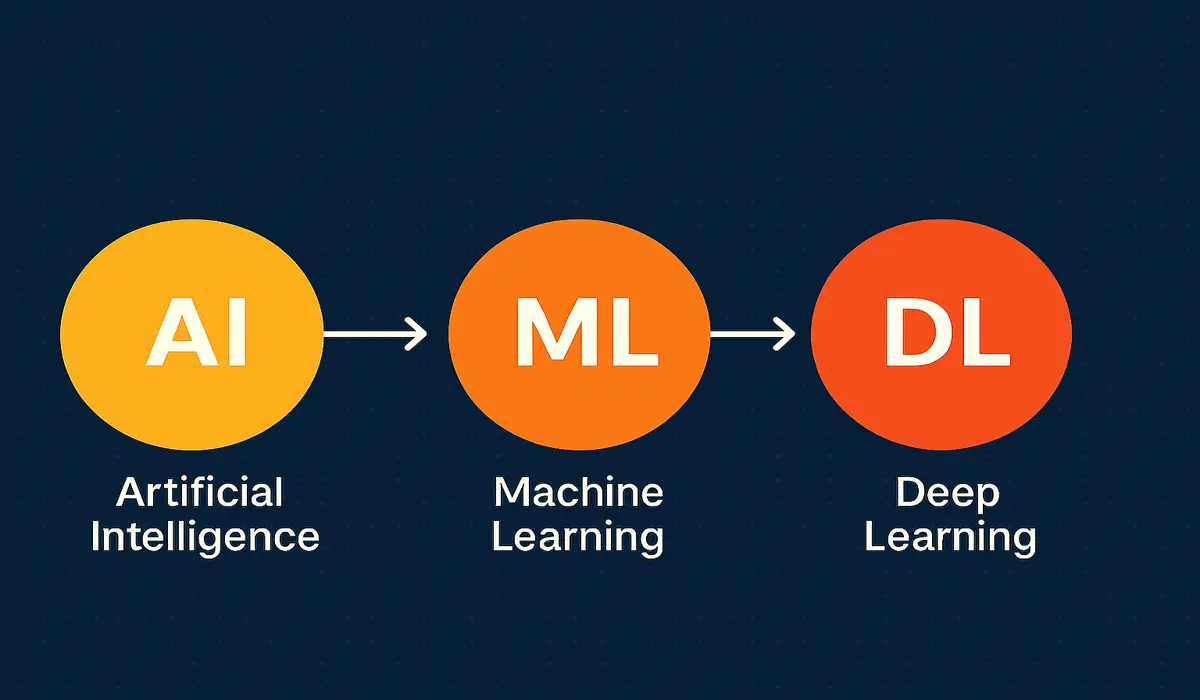
- AI is the overall science and goal.
- ML is a method used to achieve AI.
- DL is an advanced method used in ML.
Each layer builds on the previous one, becoming more complex and data-dependent.
Real-World Example: AI, ML, DL in Action
Let’s take the example of a virtual assistant like Google Assistant:
- AI: Enables the assistant to understand and respond like a human.
- ML: Helps the assistant learn your voice commands and preferences.
- DL: Powers the speech recognition and natural language understanding in the background.
Which One Should You Focus On?
If you’re just starting your journey in tech, here’s a simple guide:
- Learn AI if you’re interested in building smart systems that mimic human behavior.
- Study ML if you enjoy working with data and building predictive models.
- Explore DL if you want to work on cutting-edge technologies like self-driving cars, computer vision, and AI-generated content.
Final Thoughts
Understanding the difference between AI, ML, and DL is crucial in today’s data-driven world. While they are interconnected, each has its own unique role and complexity. Whether you’re building apps, analyzing data, or researching futuristic solutions, knowing how these technologies work will empower you to build smarter systems.
As AI continues to evolve, the boundaries between these technologies may blur even further. But with a solid foundation in their differences, you’re better equipped to navigate the exciting world of intelligent machines.
Want to dive deeper into AI tools? Check out our blog on Top AI Tools & Software or learn about the future of technology now.