Cell Towers in the Sky? It’s Happening.
Just a few years ago, the idea of using satellites as cell towers felt like sci-fi. But in 2025, it’s real—and it’s growing fast. Elon Musk’s SpaceX has quietly launched a revolution with its SpaceX Direct-to-Cell (DtC) service, turning everyday phones into satellite phones—no new hardware required.
In July 2025, Musk posted a chart showing explosive growth in upload and download data usage from Starlink’s Direct-to-Cell users. The message was clear: this isn’t a concept—it’s happening. And fast.
What Is SpaceX Direct-to-Cell?
Let’s break it down.
SpaceX’s Starlink satellites now have cellular payloads. These act like mobile towers in space, allowing your existing 4G/5G phone to connect directly to satellites when there’s no ground coverage. No satellite dish. No bulky antenna. Just your phone.
Right now, the service supports:
- Text messaging (SMS, MMS)
- Emergency services
- Location sharing
Next up: voice calls and mobile broadband.
Who’s Using It Already?
As of mid-2025, these carriers are onboard:
- T-Mobile (USA) — Their “T-Satellite” plan launched publicly in July 2025 for $10–15/month. It works on 60+ popular smartphones with no hardware changes.
- Telstra (Australia) — Running rural tests with positive early results.
- Rogers (Canada) and Optus (Australia) — Actively trialing services.
- Kyivstar (Ukraine) — Will be first in Europe with messaging by end of 2025 and full voice/data by mid-2026.
It’s spreading fast, especially in countries where traditional mobile coverage is limited or under threat.
Proof It Works: Elon Musk’s Chart
In July 2025, Elon Musk shared a chart on X showing month-by-month growth:
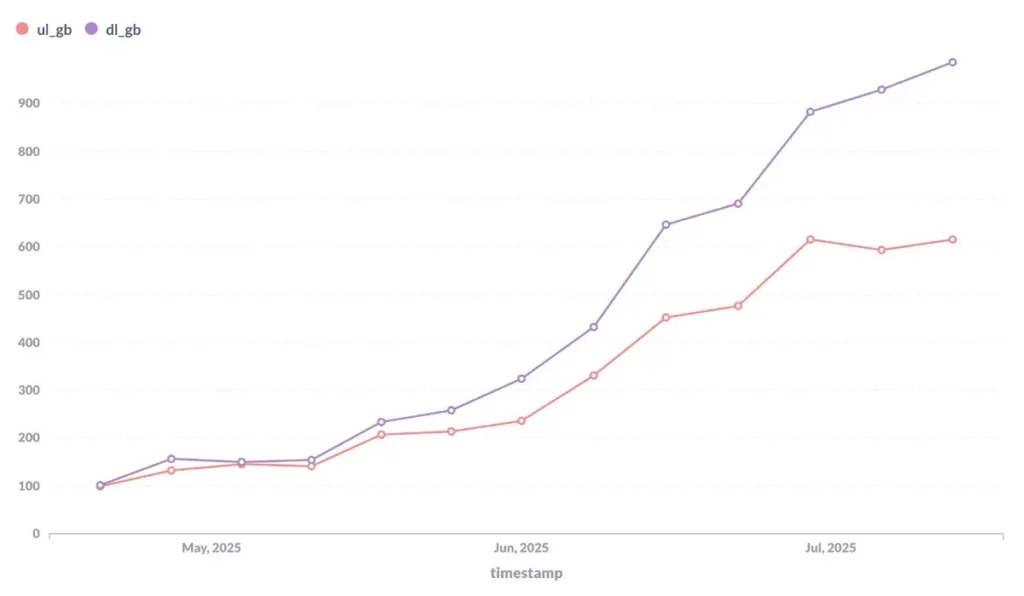
| Month | Upload (GB) | Download (GB) |
|---|---|---|
| May | ~100–200 | ~150–250 |
| June | ~300–500 | ~500–700 |
| July | ~600+ | ~900+ |
How Does It Work?
- Starlink Satellites are now equipped with 4G LTE radios.
- Your phone connects when no tower is reachable.
- Satellites use laser links to relay your signal across the constellation.
- Ground stations connect to the internet or carrier backbone.
No app. No subscription to Starlink. It just works like a normal mobile network—only it’s in orbit.
Learn more: Why Tesla’s Latest Move Has Investors on Edge
Why This Is a Big Deal
Let’s talk real-world impact:
- No More Dead Zones: Mountains, oceans, deserts—everywhere gets coverage.
- Disaster-Ready: Cell towers go down in earthquakes or war. Satellites don’t.
- Travel-Safe: Boaters, hikers, or road trippers can message even when off-grid.
- Cheaper Than Satellite Phones: No special devices, just your phone and a $10–15 add-on plan.
What’s Next in SpaceX?
According to SpaceX’s roadmap:
| Feature | Launch Target |
|---|---|
| Global Texting | 2024–2025 |
| Voice Calls | Late 2025 |
| Mobile Data | Early 2026 |
| IoT Devices | 2026–2027 |
What Could This Change?
- Global equality in connectivity — rural kids in Africa, farmers in Pakistan, scientists in Antarctica… everyone online.
- New mobile business models — carriers offering hybrid ground-satellite plans.
- Fewer ground towers needed — lowering infrastructure costs.
- IoT networks that reach anywhere — agriculture, logistics, environment monitoring.
- Better emergency response everywhere — from tsunamis to wildfires.
The Competition
- AST SpaceMobile – working with AT&T.
- Lynk Global – made early test calls.
- Iridium & Qualcomm – enabling satellite-based emergency messaging on Android.
But SpaceX has a massive lead in satellite infrastructure and rocket launches. With thousands of Starlink satellites already in orbit, they’re executing fast.
Learn more: Google Comet AI Agent: The Future of Smart Task Automation
A Turning Point for Telecom
SpaceX Direct-to-Cell isn’t just another Musk moonshot—it’s a fundamental shift in how the world connects. It breaks the rules of traditional telecom by untethering mobile networks from the ground.
One day soon, “no signal” will be a thing of the past.
Important words
- SpaceX Direct-to-Cell lets your phone connect directly to satellites.
- It’s already live in the U.S. and expanding globally.
- Usage is skyrocketing, with massive real-world adoption.
- Voice and data services are coming next.
- It could redefine how billions of people get online.