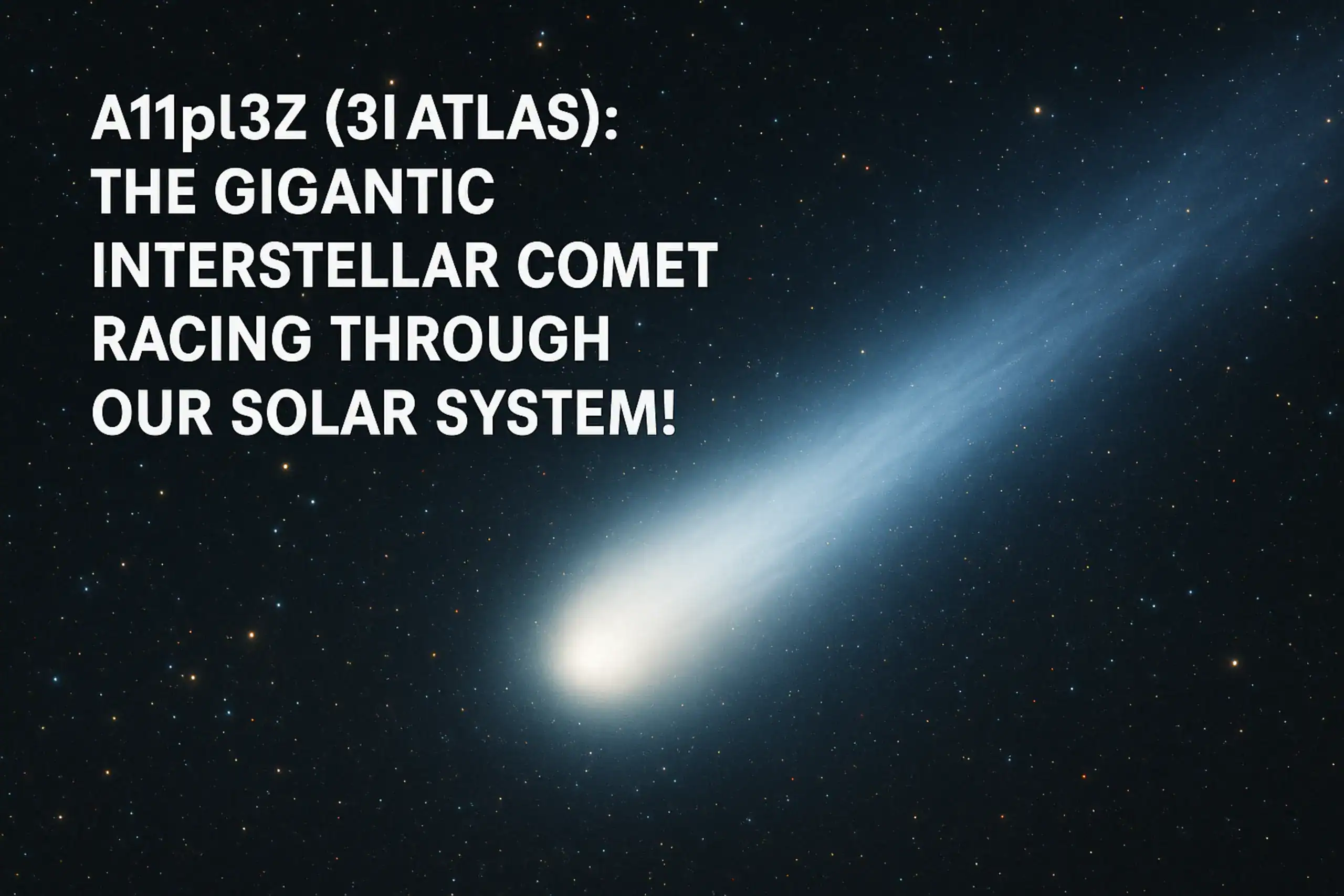
After ʻOumuamua and Borisov, a new interstellar traveler has entered our cosmic neighborhood—meet A11pl3Z, now officially known as 3I/ATLAS. This icy visitor is on a once-in-a-lifetime hyperbolic flyby through the solar system—and it’s bigger and faster than ever seen before.
What Is 3I/ATLAS (A11pl3Z)?
Discovered on July 1, 2025 by the ATLAS survey telescope in Chile, this object was initially designated A11pl3Z. Further analysis confirmed it was on a hyperbolic trajectory—meaning it comes from beyond our solar system. It quickly received an official interstellar comet designation: 3I/ATLAS (C/2025 N1).
This makes it only the third interstellar object ever recorded, after ʻOumuamua (2017) and 2I/Borisov (2019).
How Fast and How Big?
- Speed: ~61 km/s (~37 miles per second)
- Estimated size: Up to 10–30 kilometers (likely coma-inflated)
- Orbit eccentricity: ~6.1 (typical for interstellar objects)
This potentially makes 3I/ATLAS the largest interstellar object ever detected—larger than Borisov and far more massive than ʻOumuamua.
It’s a Comet, Not Just a Rock
Initial images showed a point-like object, but subsequent observations revealed a thin coma and tail. This confirms that A11pl3Z is not just a rock—it’s an active interstellar comet spewing ice and dust as it nears the Sun.
When & Where to See It
Key Dates:
- Closest to Sun (Perihelion): October 29–30, 2025 (~1.35 AU)
- Closest to Earth: December 19, 2025 (~1.8 AU)
- Observation Window: Now through early September and again from late November 2025 onward
During perihelion, it will pass just inside Mars’ orbit, but will be temporarily unobservable due to its proximity to the Sun. Once it re-emerges, amateur astronomers with mid-range telescopes will be able to observe its tail and coma.
Will It Hit Earth?
No. While large and fast, it will remain at a safe distance—no closer than 240–270 million kilometers. There’s no danger of impact, making it a spectacular yet safe show.
Live Observations Online
The Virtual Telescope Project has already streamed its early pass. Future live sessions are expected as the comet brightens. Bookmark their page or follow UpdateSaga for upcoming viewing links!
Why It’s a Big Deal for Science
Each interstellar object is like a postcard from another star system. Studying 3I/ATLAS could reveal:
- Clues about planet formation in other solar systems
- Composition of interstellar ices and dust
- How far this object may have traveled over billions of years
This comet likely originated from a distant star and wandered for eons before entering our system.
Quick Facts Table
| Feature | Details |
|---|---|
| Official Name | 3I/ATLAS (C/2025 N1) |
| Discovery Date | July 1, 2025 |
| Origin | Interstellar (outside the solar system) |
| Estimated Speed | ~61 km/s |
| Closest Approach | 1.8 AU from Earth (Dec 2025) |
| Comet Type | Active with coma and tail |
What’s Next?
UpdateSaga will continue to monitor this cosmic visitor. Expect:
- Observation guides for amateur astronomers
- Time-lapse images from observatories
- Expert analysis from space scientists
Be sure to subscribe and follow our Space & Astronomy category for continuous updates.
Final Thoughts
The universe just dropped by to say hello. 3I/ATLAS is a rare glimpse into the interstellar unknown—a frozen traveler carrying stories from a distant star. Don’t miss your chance to follow its journey.
Stay curious. Stay cosmic. Stay tuned to UpdateSaga.