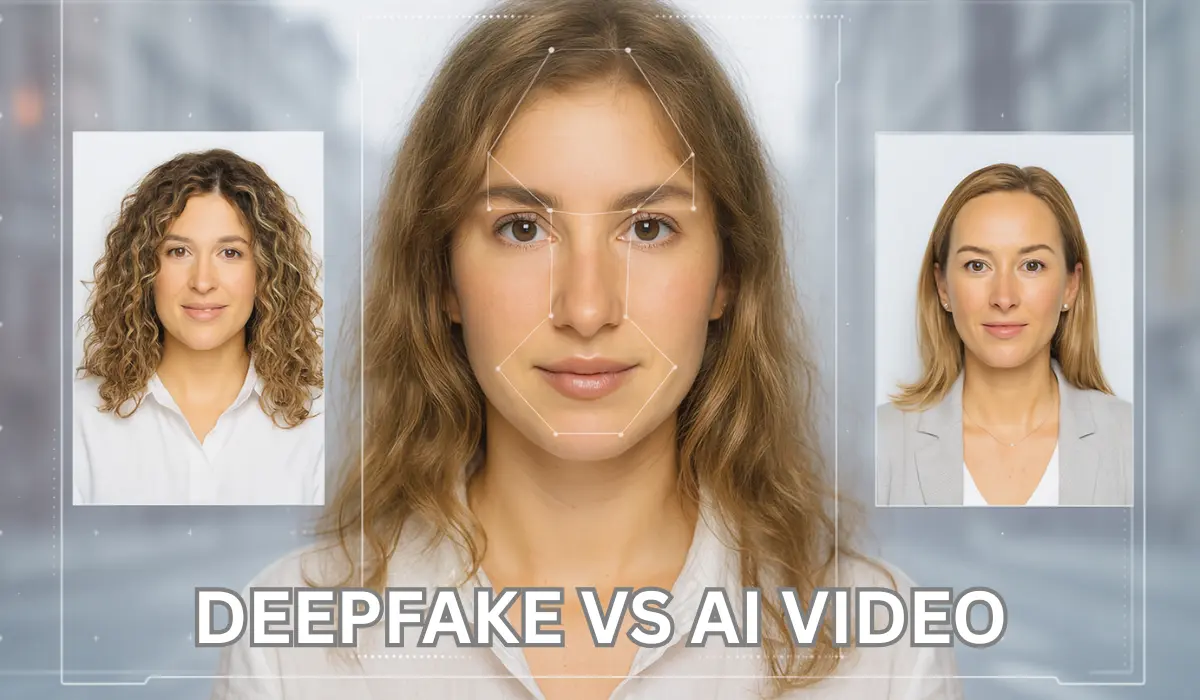
AI-generated content has officially crossed into uncanny territory. From deepfakes of politicians giving fake speeches to AI-generated influencers smiling in tropical paradise — the line between real and artificial is vanishing. So here’s the question: how do you spot the difference between a deepfake and a regular AI-generated video in the future?
Let’s break it all down — the tech behind each, how they’re used, what clues you can catch, and where this is all heading.
What Is a Deepfake?
A “deepfake” is a fake video generated using deep learning — specifically a subset of AI called GANs (Generative Adversarial Networks). These models map one person’s face or voice onto another’s. The result? A video of someone saying or doing something they never actually said or did.
Common types of deepfakes:
- Face swaps: Celebrity faces on other people’s bodies.
- Lip syncs: Matching fake audio with real footage.
- Voice cloning: AI-generated speech mimicking a real person’s tone and cadence.
- Full-body puppeteering: Mimicking gestures and body language to match a fake script.
What Is an AI-Generated Video?
Unlike deepfakes, which manipulate real footage, AI-generated videos are created from scratch. No actor, no camera — just prompts and neural networks. Tools like Runway ML, Sora by OpenAI, and Pika Labs can now create entire scenes, characters, and dialogue with zero human filming.
These are often called:
- Text-to-video AI
- Synthetic media
- AI avatars or narrators
Examples include virtual news anchors, AI-created influencers, explainer videos, and even animated storytelling clips generated with a simple script.
Deepfake vs AI Video: Key Differences
| Feature | Deepfake | AI Video |
|---|---|---|
| Source | Based on real video footage | Generated from scratch |
| Target | Mimics real people | Can be fictional or real |
| Tech | GANs, face-mapping, voice cloning | Text-to-video, diffusion models |
| Realism | Extremely high if trained well | Still improving but catching up fast |
| Main Risk | Misinformation, impersonation | Synthetic reality, content overload |
So while both fall under the “synthetic media” umbrella, the intent and origin separate them. Deepfakes twist reality; AI videos build something entirely new.
Learn more: Can You Train Your Own GPT at Home? Here’s What You Need
Real-World Uses (and Abuses)
Here’s where things get tricky. This tech is powerful — and people are using it both for good and for shady stuff.
Useful Applications
- Movies: Re-creating dead actors or de-aging stars.
- Education: AI avatars teaching in local languages.
- Marketing: Brands using AI presenters to save time and cost.
- Accessibility: Cloning voices for people who’ve lost speech.
Dangerous Misuse
- Misinformation: Fake videos of political figures causing panic.
- Fraud: AI voice calls tricking people into sending money.
- Revenge porn: Non-consensual deepfakes harming reputations.
- Scams: AI-generated spokespersons endorsing fake products.
In short: the line between innovation and manipulation is thin — and blurry.
Spotting Deepfakes: What to Look For
Even the best deepfakes tend to leave clues. You just need to know where to look:
Facial Flickers
- Unnatural blinking
- Eyes that don’t focus or move correctly
- Facial expressions that don’t match tone
Lighting Issues
- Shadow directions don’t line up
- Face lighting doesn’t match surroundings
Brain Glitches
- Lip sync slightly off
- Glasses or earrings morphing mid-frame
- Teeth or tongues blending weirdly
Voice Oddities
- Flat or emotionless tone
- Robotic phrasing or weird emphasis
And here’s the thing — while deepfakes keep improving, these little errors tend to give them away. Especially when you slow the video down.
Spotting AI-Generated Videos: Red Flags
AI-generated content from scratch has its own set of giveaways — especially in early 2025:
Unreal Environments
- Overly clean, hyper-symmetrical backdrops
- No camera shake, no depth of field, no imperfections
Plastic People
- Characters that look too smooth, too shiny
- Awkward walking animations or frozen hand gestures
Voice & Lip Desync
- Audio that doesn’t quite match lip movement
- TTS (text-to-speech) that sounds flat or generic
Repetition and Weirdness
- Reused faces, backgrounds, or expressions
- Odd gestures that don’t match human behavior
Learn more: Ultimate Comparison of the Best AI Image Generators in 2025: Features, Pricing & Accuracy
Tools That Help You Detect Fakes
Thankfully, there are smart tools — both open source and commercial — that help you detect deepfakes and synthetic content.
Popular Tools:
- Deepware Scanner: Mobile app to scan videos for deepfake likelihood.
- Hive Moderation: Enterprise-level deepfake detection via API.
- Reality Defender: Real-time browser extension that flags potential fake content.
- Microsoft Video Authenticator: Assigns confidence scores for manipulated media.
- AI or Not: Helps detect AI-generated images and videos.
These tools aren’t perfect — but they’re catching up fast.
How the Tech Is Evolving
Here’s what you need to brace for:
1. Real-time Deepfakes
Imagine someone attending a Zoom call pretending to be you — in real-time. That’s already possible with tools like Avatarify and DeepFaceLive.
2. Perfect Lip Sync + Voice
With models like ElevenLabs and Resemble.ai, AI voices now sound nearly human. Combined with fine-tuned video, you can fake a podcast, a livestream, or an interview.
3. AI Actors for Hire
Entire platforms (like Synthesia) now offer virtual actors. You just give them a script. No filming, no casting, no studio.
4. Open-source Chaos
Deepfake software is now available for free. Anyone with a gaming PC can create hyper-realistic videos in days. That accessibility is both a blessing and a curse.
Can We Ever Really Trust Video Again?
Let’s be honest — trust in video content is eroding. With enough AI, anything can be faked.
So what’s the way forward?
Watermarks and Metadata
Big platforms (like Meta, OpenAI, and Google) are working on cryptographic metadata that proves content origin and editing history.
Media Literacy
We need to train people — especially kids — to question what they see. Spotting fakes might soon be as basic as knowing how to read.
Verified Content Protocols
Blockchain-based verification (like Project Origin) is being explored to digitally sign authentic media.
Legal Frameworks
Many countries are drafting legislation to punish malicious deepfake usage. China and the EU are leading with stricter synthetic media laws.
But ultimately, no tool or law will solve this overnight. The best defense is awareness.
Learn more: Perplexity Comet: Exploring an AI-Powered Browser
Final Thoughts
We’re stepping into an era where seeing is no longer believing. Deepfakes and AI videos are just the start — future content will be more synthetic, more persuasive, and more dangerous to blindly trust.
So here’s what really matters:
- Learn to question what you watch
- Use the tools at your disposal
- Follow credible sources
- Stay ahead of the tech
This isn’t fear-mongering — it’s reality. In the next few years, distinguishing truth from fiction will be a digital survival skill.