1. Introduction
Artificial Intelligence (AI) is no longer science fiction. From virtual assistants to self-driving cars to precision medicine, AI is reshaping industries, economies, and societies. As we step into a world tightly interwoven with AI, it’s vital to understand its future — not just the advantages but the risks and downsides too. In this article, we’ll explore the future of AI, weigh its pros and cons, and outline how we can steer it responsibly toward a safer, more beneficial tomorrow.
2. What Is Artificial Intelligence (AI)?
AI refers to computer systems that perform tasks typically requiring human intelligence: learning, reasoning, perception, language understanding, and planning. Common types include:
- Narrow AI: Specialized in single tasks — e.g., speech recognition, chess playing, or recommendation engines.
- General AI (AGI): Hypothetical future AI with human-like intelligence across domains.
- Superintelligent AI: Speculated advanced AI exceeding human cognitive abilities in virtually all tasks.
Today’s AI is narrow, but ongoing research pushes us toward more capable, autonomous systems.
3. The Future of AI: Why It Matters
AI is expected to add trillions to global GDP, improve quality of life, and unlock new discoveries. According to various forecasts, AI-driven automation and innovation could create millions of jobs—but also disrupt old ones. Understanding both sides now is essential for a future with strengthened economies, sustainable growth, and minimized harm.
4. Advantages of AI
4.1 Productivity & Efficiency
AI systems process and analyze vast datasets in seconds, far exceeding human capability. In manufacturing, robotics automate routine assembly and quality-inspection tasks. In office settings, machine learning algorithms handle data entry, scheduling, and even code-generation—freeing humans for strategic work.
4.2 Innovation in Every Industry
- Healthcare: AI-powered diagnostic tools (e.g., cancer detection via imaging), drug discovery platforms, and robotic surgery
- Finance: Fraud detection, risk analysis, automated trading
- Retail & e‑commerce: Smart inventory forecasting, personalized recommendations, dynamic pricing
- Agriculture: Precision farming via drones and sensor networks
- Transportation: Autonomous vehicles, logistics optimization
AI is sparking transformative innovation across every sector.
4.3 Personalization & Enhanced User Experience
Services are more tailored than ever: from Netflix film suggestions to personalized learning paths in e‑learning—AI adapts content in real time, boosting satisfaction and effectiveness.
4.4 Improved Decision‑Making
AI supports data-driven decisions—for example, hospitals can allocate resources based on predictive models, cities can optimize traffic flows via smart-lighting systems. Human leaders receive clearer insights to make smarter strategic choices.
4.5 New Job Categories
AI is not only replacing tasks—it’s creating new roles:
- AI ethicists, auditors & policy experts
- Data scientists & model trainers
- Prompt engineers & AI interaction designers
- AI educators and support specialists
4.6 Safety in Dangerous Environments
AI-driven robots and drones can explore hazardous places: disaster zones, deep mines, nuclear facilities, or war zones—keeping human workers out of harm’s way.
5. Disadvantages & Risks of AI
5.1 Job Displacement & Economic Inequality
AI may replace roles in manufacturing, transport, customer service, and even creative work—potentially leading to mass unemployment or wage suppression for low-to-mid skill work. Without retraining programs, income disparities could worsen.
5.2 Privacy & Surveillance
AI enhances facial recognition, mass data analysis, and real-time location tracking—raising serious privacy concerns. In authoritarian regimes, these technologies can enable invasive social control and censorship.
5.3 Bias & Fairness Issues
AI systems learn from real-world data, which often reflect societal biases. Predictive policing tools have shown racial bias. Biased hiring algorithms, loan decision AIs, and facial recognition systems can reinforce inequalities—especially if unexamined.
5.4 Security Threats & AI Weapons
- Adversarial attacks: maliciously modified inputs—e.g., altered images that fool AI
- Deepfakes: realistic fake video/audio, threatening misinformation campaigns
- Autonomous weapons: AI-controlled systems that could decide to use deadly force
These pose serious global security risks.
5.5 Automation Dependence
Over-reliance on AI systems—like self-driving vehicles or medical AIs—can lead to safety issues if systems fail or are misused. Deskilling may occur: if professionals stop practicing their core competencies, they might lose critical skills.
5.6 Ethical & Existential Risks
As AI becomes more capable, we must consider:
- Who controls superintelligent systems? Risks of runaway behavior if AI goals misalign with human values
- Moral concerns: using human-like systems in caregiving/companion roles raises delicate questions
- Rights & personhood: if AI achieves consciousness, what rights, if any, should it have?
6. Striking a Balance: Towards Ethical AI
To maximize benefits while reducing harm, we need a comprehensive approach:
6.1 Responsible Development
- Adopt ethical frameworks (fairness, accountability, transparency)
- Conduct impact assessments and independent audits
- Encourage multidisciplinary collaboration: ethicists, domain experts, end-users
6.2 Regulation & Governance
- Develop policy standards for privacy, bias, and liability
- Government oversight ensures safety for consumer-facing AI (health, finance, autonomous systems)
- Global coordination via UN/tech coalitions to manage AI weaponization
6.3 Transparency & Explainability
Implement “glass-box” AI — systems that can explain their reasoning. This helps detect bugs, detect unfair behavior, and gain user trust (especially in medical diagnoses or loan decisions).
6.4 Public Engagement & Education
- Educate people on AI literacy—to critically understand AI’s strengths and limitations
- Encourage stakeholder voices: civil society, the public, and communities affected by AI systems
7. What to Expect: AI Trends Ahead
7.1 Agentic AI & Autonomous Systems
Agentic AI refers to systems that autonomously plan and act—e.g., customer-service agents handling sales with minimal human input. These agents are advancing fast and will mainstream in sectors like marketing, operations, and creative work.
7.2 AI in Healthcare, Finance, Education
- Healthcare: precision medicine with genome analysis, AI‑powered remote patient monitoring
- Finance: robo‑advisors, real‑time fraud detection, credit risk modeling
- Education: adaptive learning platforms, AI tutors for personalized pacing and feedback
7.3 Human-AI Collaboration
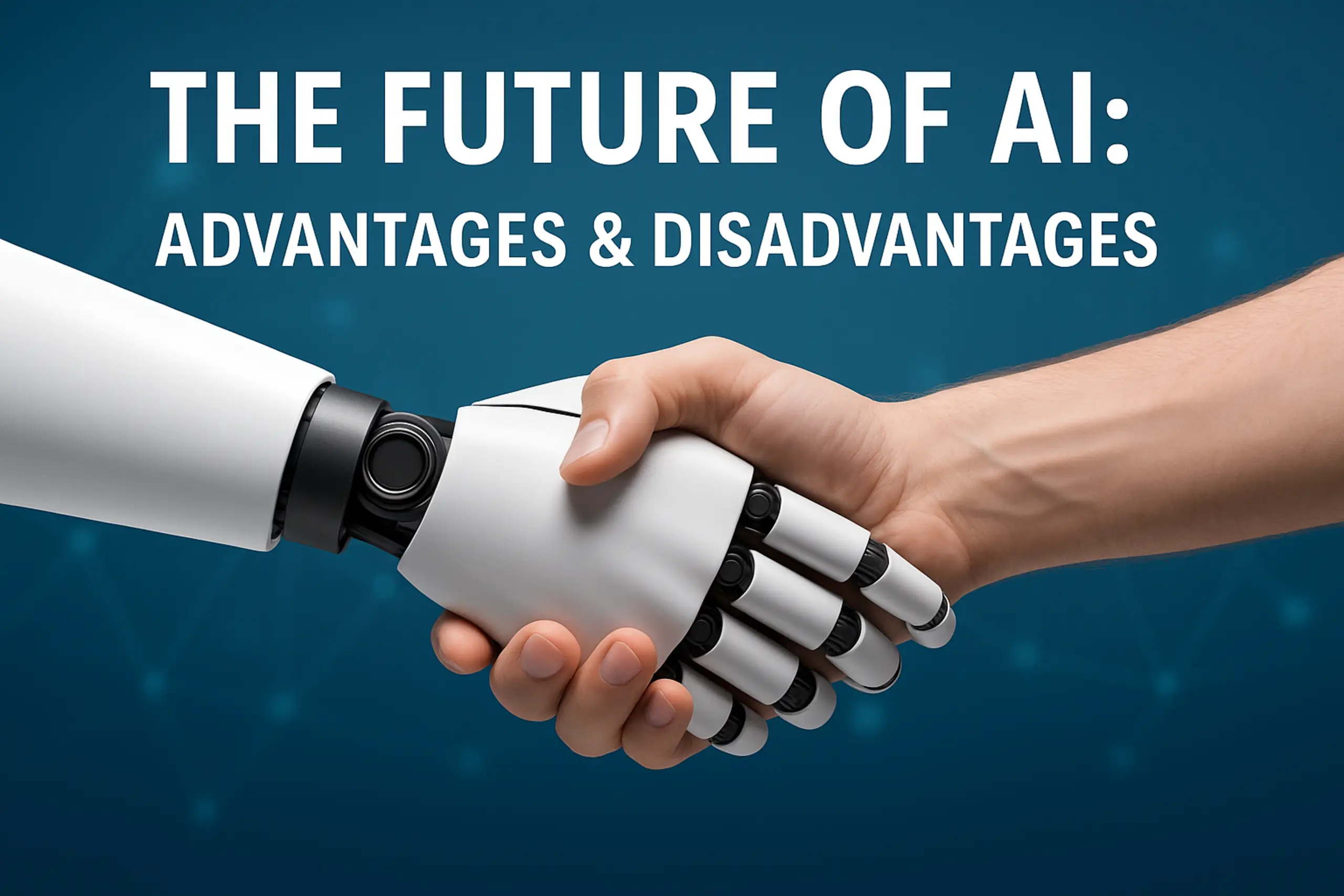
Rather than full automation, the future lies in augmented intelligence: humans working alongside AI—e.g., doctors supported by diagnostic AIs, customer‑service teams assisted by chatbots.
7.4 Sustainability & Green AI
AI can optimize energy usage, design efficient materials, and power environmental monitoring. However, training large AI models requires high amounts of energy—so the field is shifting to “green AI” to improve efficiency and reduce carbon footprint.
8. Conclusion
AI is poised to reshape the future of humanity—offering groundbreaking advantages like productivity gains, innovation, personalization, and safety, while also presenting real risks of job loss, privacy threats, bias, and existential dilemmas.
The future of AI depends on how we shape it:
- Developing it responsibly
- Regulating wisely
- Maintaining transparency
- Ensuring inclusion
If balanced right, AI has the potential to elevate society. If left unchecked, it could deepen inequalities or create new risks. As developers, policymakers, and citizens, we must work together to navigate this powerful technology for the benefit of all.
9. FAQs
Q1: What is the biggest advantage of AI in the future?
A: Productivity—AI automates data analysis, manufacturing, logistics, and more, enabling faster innovation and freeing human effort for strategic roles.
Q2: Will AI cause mass unemployment?
While AI may disrupt roles, history shows workforce adaptation. New job types—especially in AI development and oversight—are emerging. Proactive retraining is key.
Q3: How can we prevent AI bias?
By auditing training data, using diverse development teams, ensuring transparency, and instituting regulatory standards for fairness.
Q4: Are autonomous weapons illegal?
Currently not universally banned, but there’s global debate and initiatives aiming to regulate, restrict, or prohibit lethal autonomous systems.
Q5: How can I stay informed about the future of AI?
Follow reputable sources: peer-reviewed AI research, policy think tanks (e.g., AI Now Institute, OpenAI, Anthropic), and press like Wired or MIT Tech Review.