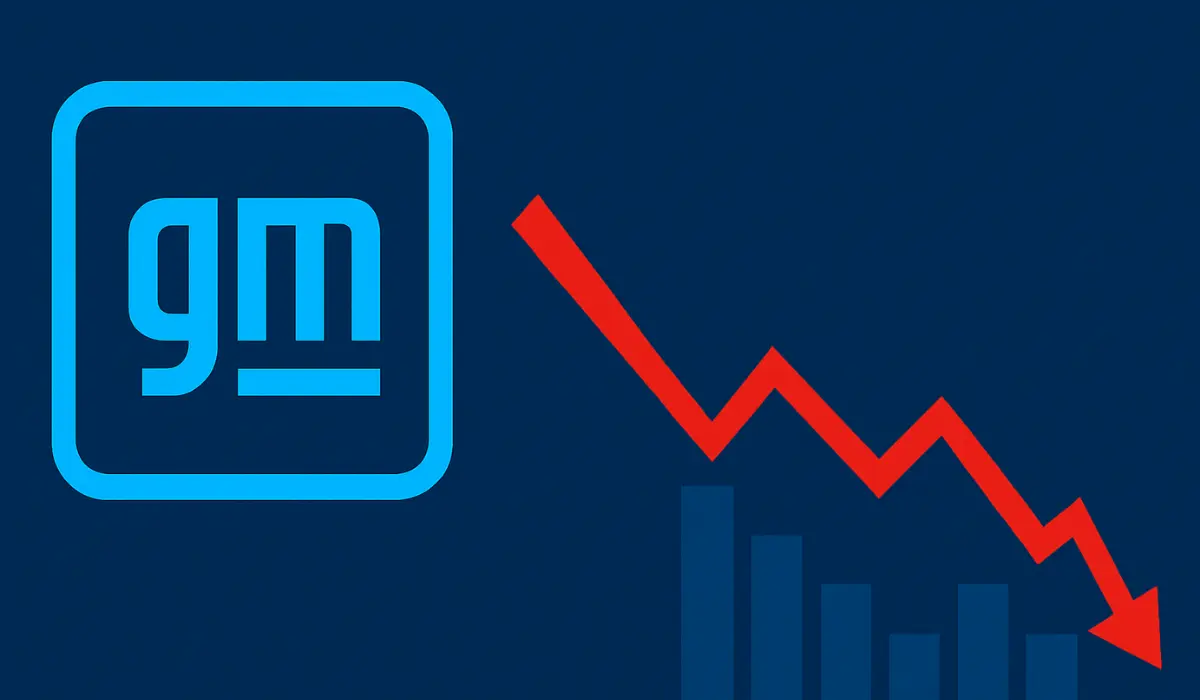
General Motors (GM) announced a significant 35.4% year-over-year decline in net income for the second quarter of 2025, declining from $2.9 billion in Q2 2024 to $1.9 billion this quarter. This sharp profit contraction primarily results from $1.1 billion in tariff-related expenses tied to trade policies under the Trump administration, which imposed steep import duties on Chinese automotive parts and electric vehicle components.
Financial Highlights – Q2 2025
| Metric | Q2 2025 | Q2 2024 | Change |
|---|---|---|---|
| Net Income | $1.9 billion | $2.9 billion | -35.4% |
| Revenue | $47.1 billion | $48.0 billion | -1.8% |
| Adjusted Earnings Per Share (EPS) | $2.53 | ~$3.06 (adj.) | Beats ~$2.32 estimate |
| EBIT-Adjusted (Operating Profit) | $3.0 billion | $4.4 billion | -31.6% |
Despite revenue dipping slightly by 1.8%, GM surpassed analyst revenue and earnings expectations, driving an adjusted EPS of $2.53 versus the projected $2.32.
Tariff Impact and Geopolitical Challenges
The reimposed tariffs on Chinese-made EV parts and materials inflicted a direct cost pressure of $1.1 billion during Q2, contributing significantly to profit erosion. The full-year tariff burden is forecasted to fall between $4 billion and $5 billion if current trade policies persist. These levies notably increased production costs and squeezed profit margins in GM’s most critical market, North America, where adjusted EBIT dropped roughly 45.5%, weighing heavily on overall results.
Learn more: 2026 Toyota HiLux Leaked: Bold New Look, Mild Hybrid Power, and Land Cruiser DNA!
GM’s Strategic Response
General Motors is actively addressing the tariff-related adversity through a comprehensive strategy including:
- $4 billion investment in U.S.-based manufacturing facilities to bring more production domestic and reduce tariff exposure.
- Supply chain realignment to source and produce closer to the U.S. market.
- Global cost-cutting initiatives.
- Gradual modest price increases (0.5–1%) in North America aimed at offsetting tariff costs.
CEO Mary Barra highlighted these measures as critical to offsetting at least 30% of the tariff burden moving forward, reinforcing GM’s commitment to operational stability and growth despite global trade uncertainties.
Electric Vehicle (EV) Market Progress
On a positive note, GM’s EV division demonstrated strong momentum in the U.S.:
- EV sales doubled to approximately 46,300 units in Q2.
- Cadillac rose as the top-selling luxury EV brand domestically.
- GM maintained a 16% share of the U.S. EV market.
Mary Barra reiterated that GM will continue scaling its EV battery production and focus on margin improvements in the EV space, which remains a central pillar of its long-term growth strategy.
Market and Investor Reaction
Even though GM beat earnings expectations, shares declined roughly 2.5% to 4% in pre-market trading reflecting investor caution due to persistent tariff risks and macroeconomic challenges. However, analysts remain optimistic, recognizing GM’s strategic agility and operational resilience.
Outlook and Guidance
GM maintained its full-year adjusted EPS guidance at $8.25 to $10.00, slightly lower than earlier forecasts but reaffirming confidence in improved second-half performance. Revenue and operating profit pressure from tariffs remains a key risk, but investments and cost controls bode well for stabilization.