Introduction: The Future is Already Here
Technology never slows down, and in 2025, we’re seeing some of the most groundbreaking innovations in history. From artificial intelligence advancing creative industries to quantum computing redefining problem-solving, emerging technologies are changing how we live, work, and connect with the world.
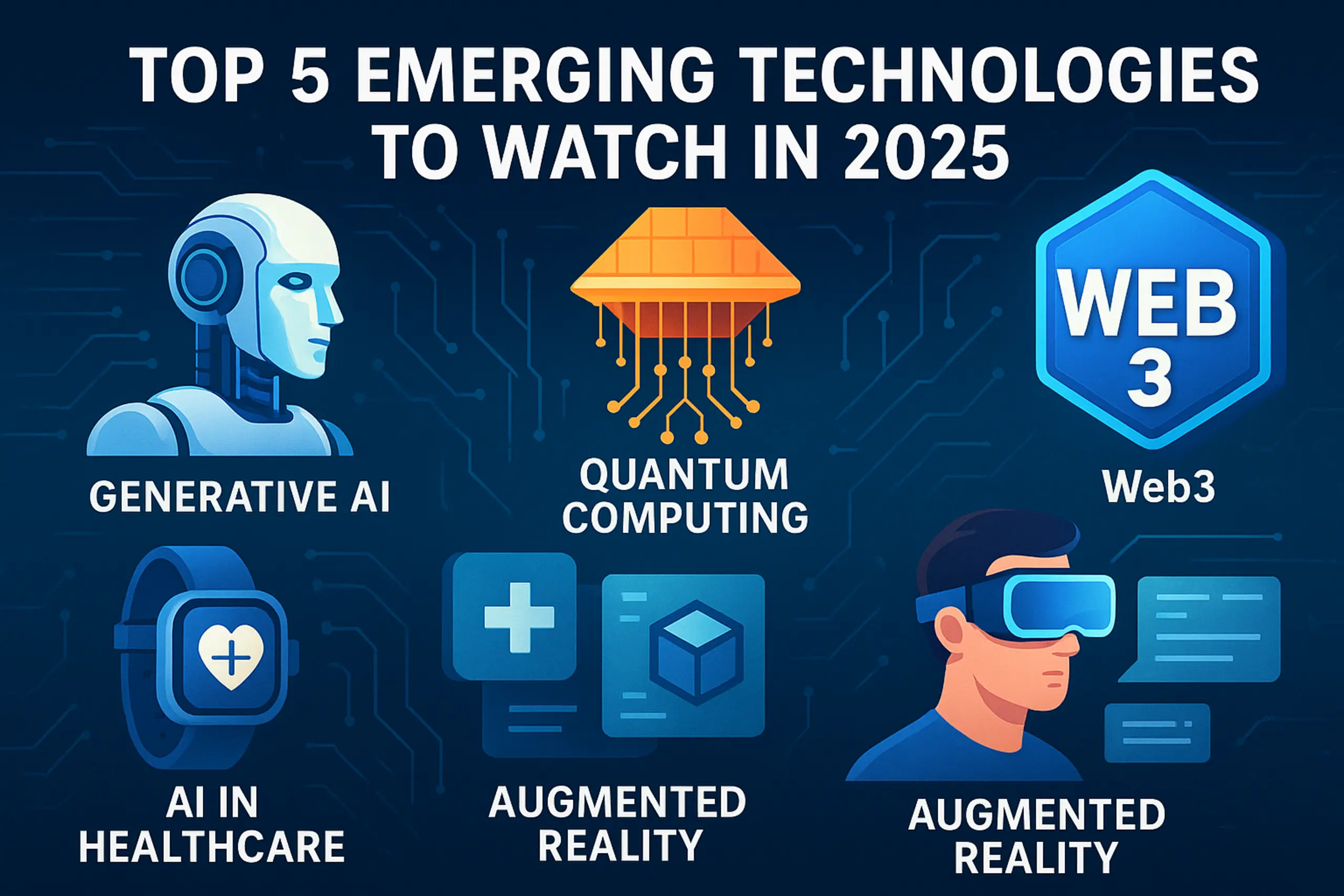
In this article, we’ll explore the top 5 emerging technologies in 2025 that are set to make the biggest impact. Whether you’re a tech enthusiast, entrepreneur, or curious reader, these trends are worth watching closely.
Generative AI and Large Language Models
Generative AI continues to dominate headlines and real-world applications in 2025. AI systems like ChatGPT, Gemini (formerly Bard), Claude, and DALL·E are transforming content creation, business automation, customer support, and even digital art.
These AI models can:
- Write detailed articles, scripts, and marketing content.
- Generate high-quality images from text prompts.
- Assist developers in writing code.
- Act as virtual personal assistants and tutors.
With improvements in understanding human emotions, tone, and context, generative AI is evolving beyond novelty and into indispensable business tools.
Quantum Computing
Once confined to theoretical discussions, quantum computing is gaining real momentum in 2025. Companies like IBM, Google Quantum AI, and D-Wave are working on quantum systems that could revolutionize fields like medicine, finance, logistics, and climate modeling.
Unlike traditional computers, quantum machines use qubits that can exist in multiple states simultaneously, enabling them to solve complex problems at speeds unimaginable with today’s processors.
Key applications of quantum computing include:
- Accelerating drug discovery.
- Optimizing global supply chains.
- Enhancing cybersecurity protocols.
- Advancing AI model training.
Web3 and Decentralized Applications (dApps)
Web3, the decentralized version of the internet, continues growing as blockchain adoption expands beyond cryptocurrencies. In 2025, more apps are being built on decentralized networks that prioritize privacy, security, and user ownership.
Web3 platforms and dApps (decentralized apps) allow users to control their digital identities, assets, and data without relying on centralized tech giants.
Examples include:
- Decentralized finance (DeFi) apps like Uniswap and Aave.
- NFT marketplaces for digital art and collectibles.
- Blockchain-based social networks and messaging apps.
- Decentralized cloud storage services like Filecoin.
As privacy concerns grow worldwide, Web3’s promise of a user-owned, censorship-resistant internet is increasingly appealing.
Augmented Reality (AR) and Mixed Reality (MR)
In 2025, Augmented Reality (AR) and Mixed Reality (MR) are moving beyond gaming and social filters into practical, everyday tools.
Tech giants like Apple, Meta, and Microsoft are investing heavily in AR devices like smart glasses and mixed-reality headsets. These devices blend digital overlays with the physical world, opening new possibilities for entertainment, education, healthcare, and remote work.
Emerging AR/MR applications include:
- Virtual meetings in 3D environments.
- AR navigation for smart cities.
- Real-time language translation via smart glasses.
- AR-based medical training simulations.
This technology is shaping up to be as essential to the future as smartphones were to the 2010s.
AI-Powered Healthcare Solutions
Artificial intelligence in healthcare is one of 2025’s most promising fields. Beyond administrative automation, AI now assists in diagnosis, treatment planning, and patient care.
Key developments include:
- AI-generated radiology reports and medical imaging analysis.
- Virtual health assistants providing real-time advice.
- Predictive analytics to foresee patient health risks.
- AI-powered robotic surgeries for precision procedures.
The combination of AI with IoT medical devices and wearable tech allows for continuous health monitoring, improving patient outcomes and preventive care.
Why These Technologies Matter
These emerging technologies are more than trends — they’re actively reshaping industries, economies, and daily life.
✔️ AI and quantum computing solve problems too complex for traditional systems.
✔️ Web3 ensures digital privacy and ownership rights.
✔️ AR and MR enhance how we work, learn, and socialize.
✔️ AI healthcare solutions improve patient care and health outcomes.
Staying informed about these technologies helps businesses and individuals adapt early and stay ahead in a rapidly evolving digital world.
Conclusion: The Future Belongs to Innovators
As 2025 progresses, these emerging technologies will only become more central to how we work and live. From AI’s creative capabilities to the decentralized promise of Web3, the tech landscape is expanding at a pace that rewards curiosity and early adoption.
For readers passionate about AI and tech, now is the time to explore these fields, experiment with tools, and consider the opportunities these innovations offer.
FAQs
Q1: What are the most important emerging technologies in 2025?
A: Generative AI, Quantum Computing, Web3, AR/MR, and AI Healthcare Solutions.
Q2: How is AI transforming content creation?
A: AI tools generate articles, images, code, and marketing copy, streamlining creative workflows.
Q3: What is Web3?
A: Web3 is a decentralized internet model where users own and control their digital assets and data.
Q4: Can quantum computing replace regular computers?
A: Not yet — quantum computers complement classical systems by solving extremely complex problems faster.
Q5: Is AR technology just for gaming?
A: No — AR is now used in navigation, remote work, medical training, and customer experiences.