Why The Race to Build AGI Matters
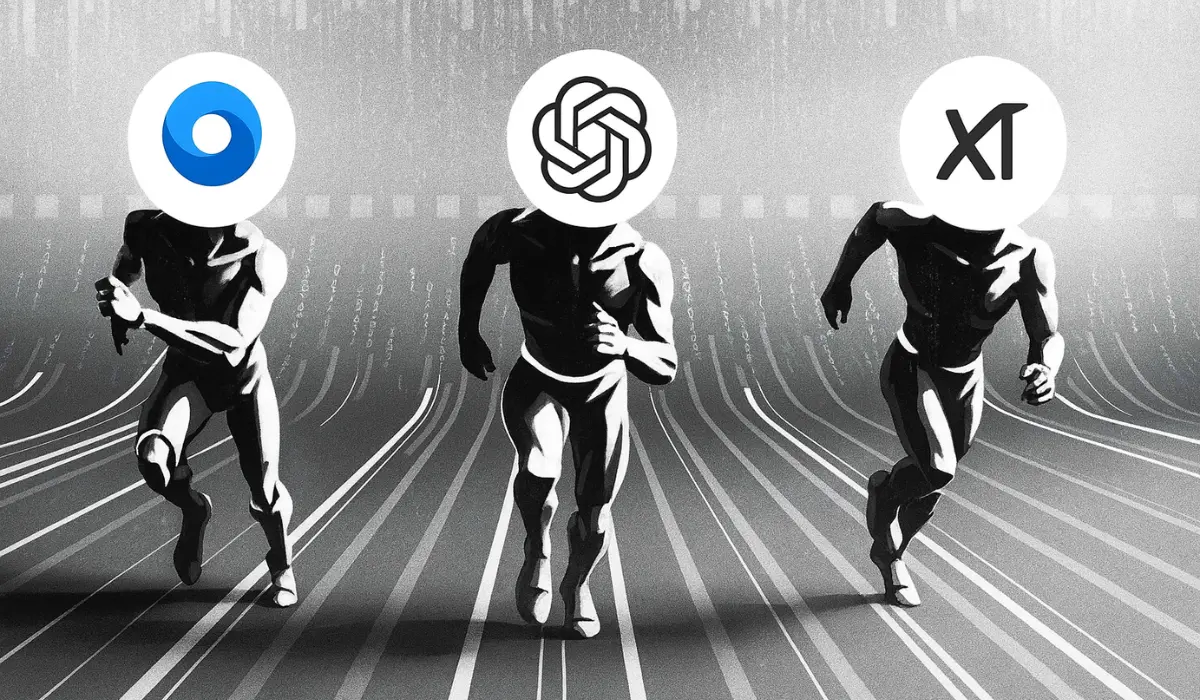
The concept of Artificial General Intelligence (AGI)—AI systems that match or surpass human intelligence in almost all cognitive tasks—has transformed from science fiction to an intense race among tech titans. In 2025, this competition is powered by OpenAI, xAI (founded by Elon Musk), and DeepMind (Google) as they deploy billions in capital, breakthrough models, and new philosophies to own the next era of intelligent machines.
- What’s at stake?
- Global economic disruption.
- Reimagined industries, jobs, and even creativity.
- Profound ethical and existential questions for humanity.
This blog is your comprehensive, copyright-free, SEO-optimized breakdown of each contender’s playbook—plus market numbers, risk analysis, technical deep dives, and what enterprise leaders and society should expect next.
What Is AGI? A Quick Primer
Artificial General Intelligence (AGI) is often defined as a machine or AI system that can outperform humans in most economically valuable work, not just excel at a single task like chess or language translation. AGI is expected to:
- Solve complex problems across domains (medicine, science, art, strategy).
- Learn and adapt autonomously, without needing narrow task-specific data.
- Potentially self-improve, accelerating its own development.
Key traits:
- Generalization (not just memorization).
- Reasoning, abstraction, and creativity.
- Autonomy over long timeframes.
How Close Are We to AGI?

Expert predictions have accelerated rapidly in the past two years, with leading voices offering aggressive public targets:
| Group | AGI Timeline |
|---|---|
| OpenAI / Sam Altman | 2025 “may see first workforce AGI agents” |
| Anthropic | 2026-2027 for superintelligence |
| DeepMind / Demis Hassabis | “Plausible by 2030”, expects gradual improvement |
| Mainstream consensus | 2040-2060 (older), now median estimate around 2047 |
Note: There are skeptics who believe these timelines are far too optimistic, citing persistent technical and societal hurdles.
1. OpenAI’s AGI Strategy: “AGI By 2025”
Vision and Mission
- Operates with a clear roadmap for AGI, aiming to “ensure AGI benefits all of humanity.”
- Shifting from static assistants like ChatGPT to agentic architectures—AI that operates as digital co-workers or autonomous agents in business and society.
- Focuses on broad usefulness, safety, and responsible rollout.
Technology and Roadmap
- Transformer Architectures:
Core breakthroughs in large language models (LLMs—e.g., GPT series), with multi-modal capabilities (text, images, code). - Five-Level Pathway:
- Conversational AI (fluent dialogue, current level).
- Doctorate-level cognitive problem-solving.
- Autonomously act for days in changing environments.
- Independent innovation & creation.
- Organizational management—AI running businesses end-to-end.
- Next Moves:
New GPT agents, more robust memory and context windows, and expanded business-specific AI platforms.
Governance and Philosophy
- Capped-profit structure: Balancing responsible AI release with incentives for investment.
- Safety & alignment: Chief focus—shipping AGI with robust testing, red teaming, and strong “alignment” protocols before large-scale deployment.
- Open partnerships: Invites developer ecosystem growth via APIs, plugins, and joint research.
Unique Advantages and Risks
| Advantages | Challenges / Risks |
|---|---|
| Early mover, huge deployment base | Intense competition, regulatory risk |
| Deep technical expertise | AGI alignment & safety challenges |
| Openness and partnership model | Potential for “rushing” too fast due to competition |
also read: Why Satellite Messaging Will Be Standard on Flagship Phones by 2026
2. xAI (Elon Musk): The Disruptor Approach
Vision and Origin
- Founded by Elon Musk in 2023 as a direct response to perceived limitations and “safetyism” at OpenAI.
- Merged with X (former Twitter) and X Corp. to centralize data, user base, and distribution platform.
- Goal: Build AGI as soon as possible, with emphasis on “truthfulness, transparency, and real-time awareness” to “benefit civilization”.
Technology and Roadmap
- Grok: xAI’s flagship—an AI trained on real-time, real-world data from X social platform, giving it unparalleled situational awareness and rapid response ability.
- “Colossus” Supercomputer:
Building one of the world’s largest AI compute clusters for scaling next-gen models. - Vertical Integration:
Ties with SpaceX, Tesla, and other Musk ventures, leveraging proprietary data (e.g., autonomous vehicle feeds) for rapid cross-domain learning and deployment. - Fast iteration: Expect regular, direct public releases and high-profile demos.
Governance and Philosophy
- Operates with tight central control: data, platform, and output standards all kept in-house.
- Combines aggressive capital investment with celebrity branding, aiming for viral consumer adoption and media attention.
- Musk’s vision prioritizes “open debate” and “unfiltered discourse” over excessive cautiousness.
Unique Advantages and Risks
| Advantages | Challenges / Risks |
|---|---|
| First-mover with live user engagement (via X) | Heavy dependence on Musk for vision, direction |
| Largest, real-time, unfiltered data corpus | Potential for governance, bias, or safety issues (speed over caution) |
| Deep integration with multiple Musk technology stacks | Valuation based more on promise/narrative than current profitability |
3. DeepMind (Google): “Safety First, Science Driven”
Vision and Core Philosophy
- Founded in 2010, DeepMind aims for AGI guided by both scientific discovery and ethical responsibility.
- Pursues a “matrixed approach”—advancing AI across multiple modalities (language, vision, planning, science) with rigorous safety guardrails.
- Historically, more conservative timeline: AGI “plausible by 2030”.
Technical Approach
- Neuroscience-Inspired Algorithms:
Mimic human cognitive learning processes, with advances in reinforcement learning (RL), hierarchical learning, and multi-task models. - Highlights:
- AlphaGo, AlphaZero: mastery in strategy games through RL.
- AlphaFold: major biology impact (protein folding prediction).
- Gato, Gemini: multi-modal agents solving tasks across domains.
- Meta-learning:
Develops systems to quickly learn new tasks with minimal data—crucial for AGI adaptability.
Safety & Governance
- Operates under Google/Alphabet, with global scale in data, compute, and research staff.
- Publishes technical frameworks for pre-deployment risk assessment, model audits, alignment research, and multi-layer controls against misuse or “misalignment.”
- Cautious rollout philosophy, preferring gradual improvement and transparency over “shock and awe” releases.
Unique Advantages and Risks
| Advantages | Challenges / Risks |
|---|---|
| Deepest scientific expertise, safety leadership | May be leapfrogged by faster, risk-tolerant rivals |
| Massive compute, big company resources | Potential inertia, less “agile” than startups |
| Proven track record with “AI for Science” | Focus on gradual improvements may miss market windows |
also read: SpaceX Direct-to-Cell: The Future of Mobile Connectivity without Cell Towers
4. AGI Market Size, Growth, and Enterprise Impact
Market Data and Projections
- AGI market in 2024: $3.87B
- AGI market in 2035: $116B (projected, CAGR ~36%)
- Over 520 companies globally, 370+ startups, major hubs in US, UK, China, India.
Key trends:
- 29% annual growth in 2024.
- 110+ patents filed (US & China lead).
- Rapid M&A, workforce >45,000 employees across AGI-related firms.
Investors, tech giants (e.g., Microsoft for OpenAI, Alphabet for DeepMind) and a new wave of venture capital are supercharging the industry.
Enterprise Use Cases (2025 and beyond)
- AI agents for business optimization (finance, logistics, customer support).
- AI-driven drug discovery, scientific R&D, and autonomous research platforms.
- Creative content generation, superhuman-level design, and real-time market forecasting.
5. AGI Safety, Alignment, and Governance Best Practices
Building AGI is not “just another tech competition.” Public and expert concern about AI alignment—the risk of superintelligent systems acting against society’s interest—has never been higher.
Key best practices (emerging consensus in 2025):
- Pre-deployment risk assessments and “red teaming.”
- Independent third-party audits and safety restrictions.
- “Alignment” research to ensure systems follow human intent, not drift from it.
- Clear protocols to halt development/deployment upon serious risks.
OpenAI, xAI, and DeepMind all state commitment to safety, but each with a unique risk philosophy:
- OpenAI: Balances speed and safety, high transparency.
- xAI: Moves fastest, takes more risk, bets on “truthfulness via transparency.”
- DeepMind: Prioritizes alignment, transparency, and governance, even over sheer speed of launch.
also read: Can You Train Your Own GPT at Home? Here’s What You Need
6. The Competitive Landscape: Comparison Table
| Aspect | OpenAI | xAI (Elon Musk) | DeepMind (Google) |
|---|---|---|---|
| AGI Estimated Timeline | 2025 | “As soon as possible” | 2030 (plausible) |
| Technical Focus | Agentic AI, transformers | Supercomputers, real-time data, Grok | Reinforcement learning, meta-learning |
| Unique Advantage | Openness, partnerships, early traction | Platform/data vertical integration, Musk ecosystem | Science-first, safety, multi-modal AI |
| Funding/Backing | Microsoft, venture | X, Tesla, SpaceX, direct capital | Alphabet (Google) |
| Safety Approach | Alignment, deployment audits | “Open debate/Open data,” less filtering | Cautious, detailed alignment frameworks |
| Major Weakness/Risk | Overhype, AGI safety tension | Narrative/valuation risk, centralization | Too slow to market |
7. What Does It Mean for SEO and Content Creation?
AGI and advanced agentic AI are reshaping SEO, content, and marketing in 2025:
- AI-driven search: Newer search engines and agents can answer questions directly, reducing “blue link” traffic. Marketers must optimize for AI agents as much as for humans.
- Multi-modal content: AI tools now generate graphics, video, and code alongside text—content not just for users but for other AIs to “read.”
- Continuous knowledge: With agents learning in real time (e.g., Grok on X), SEO must keep updating content for AI retraining and knowledge graphs, not just for humans.
Actionable tips for rank math SEO in the AGI era:
- Target queries AI agents use to research.
- Publish authoritative, “human-level” content—AI agents trained to value expertise and source credibility.
- Structure data for AI retrieval (schema, entities, rich snippets).
- Build partnerships with AI companies to ensure your content is indexed by agents.
8. Challenges and Risks Ahead
- Misalignment and Control:
If AGI drifts from programmed values, unintended—and potentially catastrophic—outcomes are possible. - Job transitions and social disruption:
Every wave of automation brings upheaval. AGI could accelerate this in sectors from law and medicine to the arts. - Regulatory arms race:
No clear legal consensus yet on who controls—or bears liability for—autonomous agents spanning countries and jurisdictions.
also read: Perplexity Comet: Exploring an AI-Powered Browser
A Frontier Still Unfolding
In 2025, OpenAI, xAI, and DeepMind are locked in a “moonshot” competition for the most powerful, flexible—and potentially risky—technology humanity has ever built.
- OpenAI: Fastest to market, betting on agents that co-work with humans and businesses.
- xAI: The Musk-driven disruptor, tightly integrating social media, real-time data, and a global audience.
- DeepMind: The scientist’s choice, gradual and safety-obsessed, advancing the science and governance of AGI for the long term.
The outcome will shape not just technology, but geopolitics, daily life, and the boundaries of what machines—and humans—can achieve.
Stay tuned: every enterprise, and every individual, will soon be part of the AGI world.
FAQ (Artificial General Intelligence 2025)
- Is AGI here yet?
No official AGI, but “narrow” AI is already superhuman in many domains. General AI at human level remains a moving target—early agentic systems will likely emerge in specific business/workforce contexts very soon. - What can businesses do now?
Invest in AI literacy, test new agentic platforms, and monitor AGI safety and regulatory developments closely. - Which company is winning?
Too soon to say—each has unique advantages, parallel approaches, and open technical hurdles.
“Winning” may ultimately depend on trusted governance as much as breakthrough code.
Ready for the AGI future? Start investing in skills, partnerships, and ethical policies today—and watch the race unfold.